
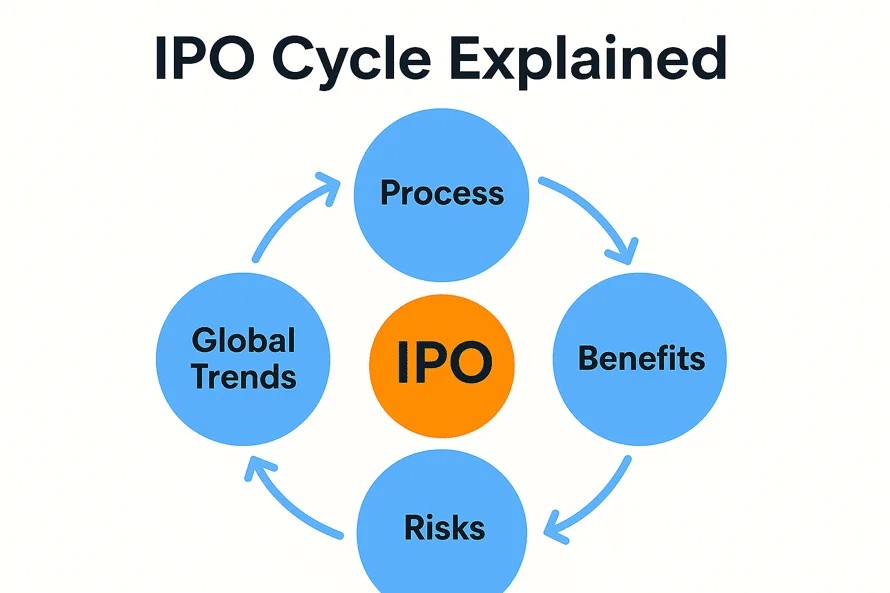
Introduction
An Ipo represents the moment a private company opens its ownership to the public for the first time. For many investors, IPOs appear attractive because they offer early access to businesses entering the public markets. However, participating in an IPO requires more than enthusiasm. Understanding how IPOs work, how pricing is decided, and what happens after listing helps investors approach them with clarity rather than speculation.
What Is an IPO and Why Companies Launch One
An IPO, or Initial Public Offering, is the process through which a company issues shares to the public and gets listed on a stock exchange. Until this stage, ownership is usually limited to founders, early investors, and private institutions.
Companies choose the IPO route to raise capital for expansion, repay debt, or provide liquidity to existing shareholders. For investors, an IPO creates a new Investment opportunity tied to the future growth of the business.
The IPO Preparation Process
Before an IPO reaches investors, a long preparation phase takes place. This includes regulatory approvals, financial disclosures, and valuation exercises.
Key steps in the preparation phase include:
- Appointment of intermediaries
- Detailed financial audits and disclosures
- Drafting of the offer document
- Regulatory review and approvals
This process ensures transparency and protects investor interests by making critical information publicly available.
How IPO Pricing Works
IPO pricing is not random. It is based on the company’s financial performance, growth potential, industry position, and broader market conditions.
There are typically two pricing approaches:
- Fixed price issues, where the share price is predefined
- Book-built issues, where investors bid within a price range
Demand during the bidding period helps determine the final price. Strong demand often signals market confidence, while weak demand may reflect valuation concerns.
Understanding the IPO Subscription Process
During the IPO window, investors apply for shares through a regulated bidding process. Applications are categorized into different investor groups, each with reserved quotas.
If demand exceeds supply, shares are allotted proportionally or through a lottery mechanism. Not all applicants receive shares, especially in heavily subscribed issues.
This phase highlights why IPO investing should be approached with realistic expectations rather than assumptions of guaranteed allotment.
What Happens After Listing
Once listed, the IPO transitions into regular market trading. Share prices may move sharply in the initial days due to demand–supply imbalances and market sentiment.
Some IPOs list at a premium, while others may trade below their issue price. Short-term price movement does not always reflect long-term business quality, making patience important for investors with a longer horizon.
Post-listing performance often depends on earnings delivery rather than listing-day excitement.
IPOs as a Long-Term Investment
While some investors aim for short-term listing gains, others evaluate IPOs as long-term holdings. For long-term Investment, assessing fundamentals matters more than initial price movement.
Key factors to evaluate include:
- Revenue growth consistency
- Profitability trajectory
- Competitive positioning
- Management credibility
IPOs of fundamentally strong companies may reward patient investors over time, regardless of early volatility.
Risks Associated With IPO Investing
IPO trading carries specific risks. Limited public trading history makes valuation challenging. Promotional narratives may sometimes overshadow actual financial strength.
Other risks include:
- Overvaluation due to hype
- Short-term volatility after listing
- Changes in business conditions post-IPO
Understanding these risks helps investors avoid emotional decisions driven by market excitement.
IPOs vs Existing Listed Stocks
Unlike established stocks, IPOs lack historical market pricing data. Existing listed companies offer more transparency through long-term performance records.
For this reason, IPOs should usually form a smaller portion of a diversified portfolio. Balancing IPO exposure with established investments helps manage overall risk.
Common Mistakes Investors Make With IPOs
Many investors apply to every IPO without analysis. Others focus only on listing-day gains or follow unverified market opinions.
Ignoring the offer document, misunderstanding business models, and overallocating capital are frequent errors. Discipline and research reduce these risks significantly.
Conclusion
An Ipo is not merely a market event but a business transition that introduces new Investment opportunities and risks. Understanding the IPO process, evaluating fundamentals, and setting realistic expectations are essential for informed participation. When approached thoughtfully, IPO investing can complement a long-term portfolio rather than disrupt it through short-term speculation.
FAQs
Are IPOs suitable for beginners?
Yes, but only after understanding the business, valuation, and risks involved.
Do IPOs always give listing gains?
No. Listing performance depends on demand, pricing, and market conditions.
Should IPOs be held long term?
That depends on business fundamentals and personal investment goals.
Is it risky to invest only in IPOs?
Yes. Concentrating solely on IPOs increases portfolio risk.
You may also like
-
How to Compare AU Projectile Sales Before Choosing Supplies
-
Why the Colour of Your Windows and Doors Matters More Than You Think
-
Why Every Growing Business Needs a Solid Administrative Foundation
-
What Makes Outdoor Team Building More Effective Than Indoor Workshops
-
Powder Coating Thickness Standards: System Aluminium Windows Manufacturers Guide